TOURING MANUAL
Rowing Canada Aviron
INTRODUCTION
Touring is different than rowing at your club. First and foremost, you will be rowing on unfamiliar water. This water should first be scouted to ensure the safety and enjoyment of the tour group. Tour participants should be alert to potential problems and hazards, and be prepared to deal with them.
In general, all participants in a tour should know how to swim, be sufficiently fit to row longer distances over several hours at a time, and have the capacity to step in and out of a boat from varied terrain (not just rowing docks).
Touring boats are wider and far more stable than racing shells. All have higher gunwales and most have large sealed buoyancy chambers allowing them to handle rougher water. For that reason they are usually not accompanied by a safety boat. All mandatory safety equipment normally carried by your club's coach boat must be carried on board your touring shell. If the tour involves traversing a body of water that calls into question the need for a safety boat, for example because sizable waves could develop quickly, it might be better to avoid that water altogether.
A rowing-compatible dock may not be available to facilitate landing. You should know how to make a beach landing, how to deal with a rocky shore, and how to come alongside a dock higher than the boat's riggers.
This manual is intended to provide rowers with the basic information required to undertake touring safely and enjoyably.
Although this guide addresses issues specific to touring, tour participants should also consult RCA's Safety Guidelines and Weather Protocol .
Tour participants make lasting friendships while discovering Canada's waterways. Touring in rowing boats is much like canoe tripping - except for the speed. You will experience the natural world, and may be able to sneak up on wildlife. You will enjoy powering past canoes struggling against a headwind. Do join us!
ROLES AND RESPONSIBILITIES
The first objective of every rowing trip is safety. The second objective is to prevent equipment damage.
Both are the responsibility of all tour participants.
On a tour, there are typically three levels of command:
The Tour Leader is in charge of the overall planning and organization of the trip, including:
- Choosing Boat Captains before the trip begins
- Ensuring that Canadian Coast Guard Regulations are observed
- Preparation of the trip route, maps, charts, instructions, weather forecast, rendezvous locations for participating boats and for accompanying vehicles, plus emergency landing sites
- Knowing how to read a marine chart and/or a topographical map. The tour leader should have a detailed chart for unfamiliar waters or a less detailed map, but with directions from people who know the waters, warning of specific dangers (shallow water, deadheads, rocks, etc.).
- Scouting out the route of the tour and have plans in case of bad weather or other problems, including emergency landing beaches/docks
- Briefing the coxswains/captains of participating boats about the day's course before setting out
- Ensuring that all tour participants attest to their ability to swim.
When several boats participate in a tour, the Tour Leader should keep the boats together (within sight or hailing distance of each other) at all times. If the boats are likely to travel at very different speeds, they should be arranged into "buddy pairs/groups" which should agree to stay together.
The Boat Captains are in charge of their boats, equipment and safety, including observance of Coast Guard regulations, and choosing their coxswain. The Tour Leader need not be a Boat Captain.
The Coxswain (Cox) is in charge of steering a boat. The cox need not be a Boat Captain. Indeed, the position of cox is likely to change throughout the trip, possibly several times in a day.
The cox is responsible for maintaining the course of his/her boat and for issuing rowing commands to the crew. The cox operates under the general guidance of the Boat Captain, and if applicable remains within hailing distance of boats within its assigned group.
Every cox should understand how motorboats and sailboats maneuver, and to steer the rowing boat so as to give other boats "sea room." In particular, the cox should understand that:
- the sails of a sailing boat often restrict the view of the helmsman
- the course a sailing boat can steer is largely dictated by the wind - leave them room to tack!
- the course of a personal watercraft is totally unpredictable - give them lots of room!
- large motorboats (cruisers, etc) tend to keep a straight course
- large motorboats & sailboats require deep water and may not be able to avoid you if doing so would send them out of the main channel.
In coxless boats, the bow rower takes on the responsibility of steering. Coxless boats should allow a coxed boat to lead them, particularly through shoal waters or other hazards.
Before starting a tour, all participants should know how to swim, and should advise the tour leader and other tour participants if they have any potential medical conditions.
SAFETY REGULATIONS (Canadian Coast Guard)
Under the Canadian Coast Guard regulations, a rowing boat is considered to be an un-powered craft and treated in the same way as a sailboat. The rules state:
- power boats give way to unpowered boats
- both power and unpowered boats must give way to large craft which can only operate in a shipping channel
- unpowered boats give way to other unpowered boats on their starboard quarter
- when approaching head on, two boats should steer so as to pass each other to port
NOTE: The above is a condensed summary of the Coast Guard Regulations - which change from time to time. For more information visit the Coast Guard web site and the Office of Boating Safety site
EQUIPMENT
- Boat(s) should be in good condition. Check boats, seats, blades & riggers before taking a boat on tour.
- Obtain maps, charts, or detailed written directions before setting out. One copy should be aboard each boat in a transparent waterproof (zip-lock) bag.
- One personal flotation device (PFD) must be carried for every participant on a tour.
- Take tools (for riggers, oarlock pitch, seats, tracks, plus pliers) and parts (rigger nuts, footstop bolts, washers, spare oarlocks, oar collars), plus duct tape, etc for repairs. You should know what spares your boat needs.
- One or two spare blades should be taken on each trip. These can be carried by simply laying them on top of the riggers of one of the boats.
- One bailer or pump, one whistle (or other signaling device), a bow line and a stern line must be on board each boat, as well as a signaling or flash light.
- One fully stocked first aid kit must be taken on each trip: containing such items as disinfectant, bandages, sunscreen, insect repellant, anti-histamine cream, etc.
- Each boat should have a paddle and a boathook to help maneuver near a dock or lock wall.
- All participants are responsible for packing appropriate clothing and for ensuring that this is packed so that it remains dry in case of rain or capsize.
- Each boat should be equipped with a functioning cell phone or other similar communication device such as a VHF radio or walkie-talkie.
NOTE (1): Check your equipment to ensure that it complies with Canadian Coast Guard requirements.
NOTE (2): A cell phone may be useful,
but only if there is service in the areas through which you will be rowing.
PREPARING TO ROW
The Boat Captains and the Tour Leader should do the following:
- Make sure that a sealed transparent plastic bag (eg: zip-lock) containing a map and/or route instructions is on each boat or in the hands of one of each "buddy group."
- Obtain a recent weather forecast for the area and be prepared to change or cancel plans if the weather is likely to be bad.
- Assign the crews to boats. Try, if possible, to accommodate the crew's wishes. However, make sure that the crews are roughly balanced as to strength and skill so that some boats will not surge ahead while others lag behind. Each boat should have at least one crew member who is a capable rower and experienced in touring.
- Ensure that each crew checks their riggers, footstops, seats and other equipment prior to launching. The Boat Captains or coxswains should be asked to repair or report any breakages or problems to the trip leader.
- Order each crew to launch their boats, alone or with help from other crews, depending on the launch site. Rowers should not launch if motor boats are making waves - wait for the waves to subside to avoid damaging the boat.
- Supervise the loading of PFD's, oars, rudder and other equipment. Make sure that baggage is sensibly stowed, and does not overload the boat.
LAUNCHING REQUIRES TEAMWORK!
- Touring boats are heavier than racing shells. Accordingly, boats are not launched by pressing them overhead and then lowering them into the water.
- The boats have neither a fin keel nor a rudder protruding below the hull, so they can be laid directly on the soft, grassy ground, but not on rocks. Boats can then be launched by sliding the hull directly into the water.
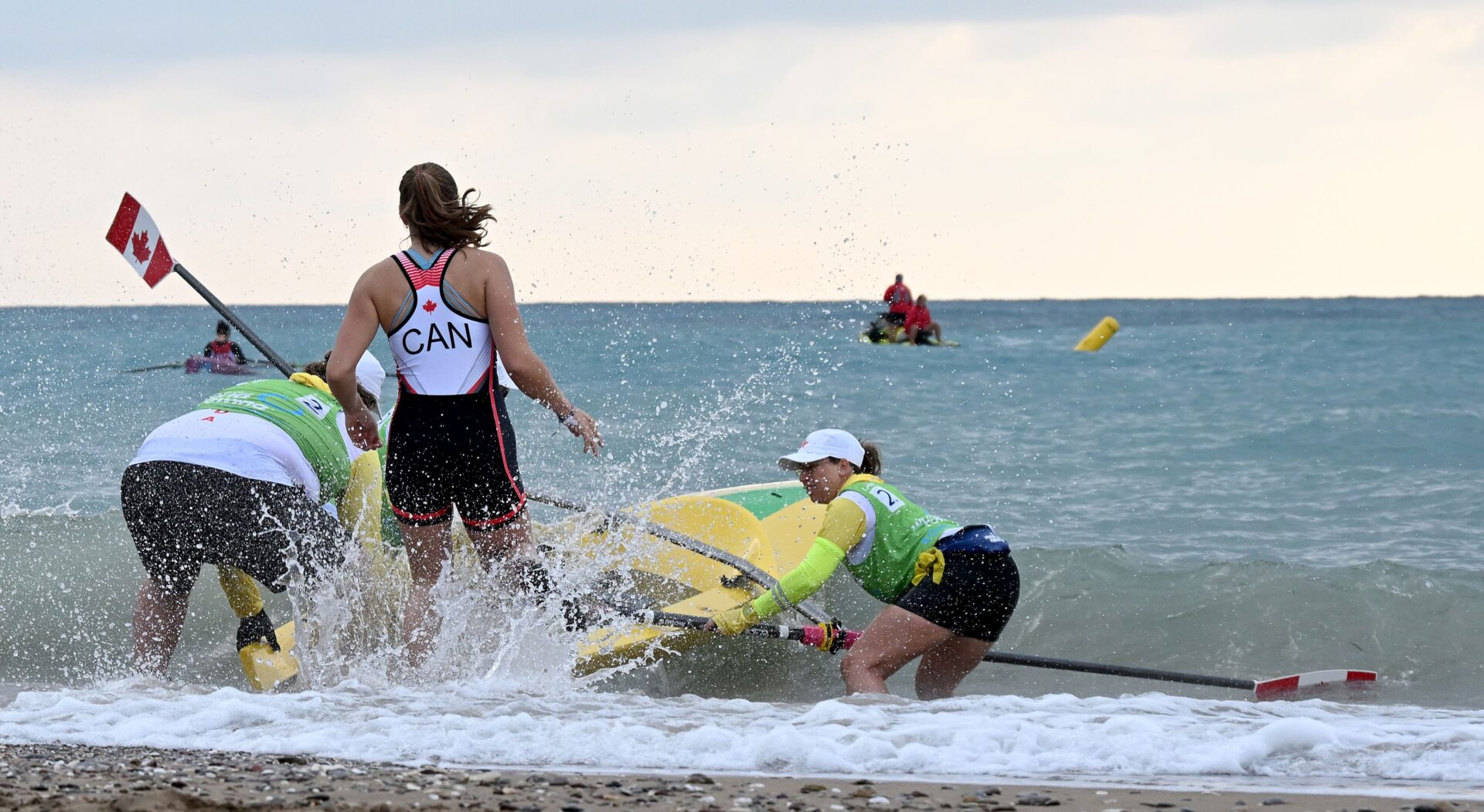
- Launching should not be done by sliding the boat on a rocky shore. Instead, the crew should carry the boat right side up by its gunwales and walks into the water carrying the boat. Under these conditions, it is preferable to have six or more people to launch a boat.
- As in a racing shell, before you embark, all the blades should be installed and their gates closed and locked. In addition, any baggage should be stowed before people begin to get in. Occasionally, when embarking from a high dock, one person may have to embark first to stow baggage.
- You get into a touring boat exactly as you would get into a racing shell. However, you often do not have the luxury of stepping off a low level dock! You generally embark as from a beach launch - standing in knee-deep water.
- Occasionally, you may have to embark from a rocky shore, or from a very high dock. Both situations can be difficult and should only be attempted under the direct guidance of a person with touring experience.
- If the dock is suitably low, the entire crew can board simultaneously. Otherwise, board one at a time. Take great care. As baggage is loaded and people embark, the boat sinks lower in the water. Make sure that the riggers never support the boat's weight. You may have to protect the riggers by moving the boat away from the dock to complete loading/embarkation.
- If boarding is from a beach, board one at a time with the rest of the crew steadying the boat. Once each rower has boarded, they should hold the boat steady with their blades for the next crew member.
- If launching from a muddy or sandy shore, rinse your feet/footwear before putting them in the boat. This will help preserve the equipment in good condition.
- Check that the course is clear before starting to row. Move the boat to the end of the dock until the bow rower is clear to row,
or
Push the bow of the boat away from the dock until the bow rower is clear to row. The bow rower may use his/her dockside blade to push off and then pull away from the dock, while the rest of the crew steadies the boat.
- Avoid setting off stern-first because the coxswain cannot steer going backwards!
STEERING - BOAT MOVING
- Always ensure that the steering rope is stowed under your feet and never wrapped around you in any way. Ensure that, if the boat overturns, you will not in danger of being tangled in the steering rope.
- Pull the steering rope on the side of the boat towards which you wish to turn. The rudder is moved to that side, pushes water towards that side, kicking the stern of the boat to the other side.
- Note that the boat cannot respond to the rudder unless it is moving through the water! The faster the boat is moving, the better it will respond.
STEERING - BOAT STATIONARY
- If the boat is stationary, drifting, or moving very slowly it can only be steered with the oars. The coxswain must give the appropriate commands. Pull with the starboard blades to move towards port, and vice-versa.
- In an emergency, steering and slowing can be accomplished simultaneously by holding water on the side towards which you wish to turn.
- In an uncoxed boat, rowers steer by rowing harder on one side or the other. Pull with the side away from which you wish to turn.
- The coxswain should be prepared to act without hesitation in an emergency. Of course, an alert coxswain will experience few emergencies.
DOCKING OR LANDING - Best against wind and current!
It is generally best to come to land/dock facing into the wind and/or the current so that the boat will stop when rowing stops. If the current is against the wind, come to land against the current and with the wind so that the boat can be steered (making way through the water) when not actually moving.
BEACH LANDING
- Approaching a beach, watch for rocks or other hazards that might damage the boat.
- Do not run the boat up the beach!
- Have one or two crew disembark before the boat grounds. Let them guide the boat in to the beach.
- If there are waves, never allow the boat to pound the shore. Put it "high and dry."
DOCK OR LOCK WALL LANDING
- Approach the dock at an angle of about 30 degrees . Gently brake with the waterside blades. This should bring the boat parallel to the dock or wall
- Make sure that the riggers will clear the dock.
OR
- Approach with caution so that the riggers do not hit the dock or wall.
- Bring the blades parallel to the boat while docking. Use a paddle to complete the docking procedure.
- All crew to fend off the dock. Never allow the riggers to take the first shock. Never allow the hull to strike the dock.
- If crew disembarks onto a low dock in calm water, all can disembark together.
- If crew disembarks onto a high dock, disembark one at a time with the rest of the crew holding the boat.
- Secure the boat with a bow and/or stern line.
STORING THE BOATS ON SHORE
- Make certain that the boats are pulled up, well out of reach of waves or any changes in water level.
- Touring boats are designed to rest safely on their flat keels, but preferably on some form of padding.
- If you expect heavy rain overnight, the boats should be stored upside down. Upside down storage can be achieved by resting the gunwales on supports (such as logs) to ensure that there is no pressure on the riggers. If this is not possible, remove the riggers.
HAZARDS
Currents
- A current can be both useful and dangerous, and should be navigated with caution. Always try to seek out the slowest safe current when heading upstream and the fastest safe current when heading downstream. However, row in a current only if it is safe to do so!
- When trying to cross a flowing river, use the current where possible. If the current is strong enough and you are able to place the boat appropriately, turning around may be achieved by the action of the current alone.
- Rowing upstream, row close to shore, allow the bow to turn into the current so that the stern swings into still water near the shore. The current may then carry the bow right around.
- Likewise, rowing downstream, aim the bow into calm water near shore while the stern is in the current. The current should now carry you around.
- Take care that you do not inadvertently execute one of these manoevers when drifting downstream in a river! When drifting, try to keep the bow pointed ready to row at all times. Always avoid drifting downstream broadside.
- Never drift downstream through a narrow passage. Always keep the boat moving (relative to the water) so that steering control is maintained!
Remember:
- The current is generally fastest in the middle of a straight stretch of river.
- On bends, the current is generally fastest on the outside of the bend.
- On bends, the calmest water on the inside of the bend is likely to have very shallow sandbars.
- The current tends to accelerate in shallow water.
- Avoid rowing near bridge abutments.
Avoid rapids. You cannot row fast enough to maintain steering control. You may not be able to row at all because of rocks. You risk smashing the boat, not to mention the hazard of injury or drowning for the crew.
You cannot row fast enough to maintain steering control. You may not be able to row at all because of rocks. You risk smashing the boat, not to mention the hazard of injury or drowning for the crew.
Large Lakes
Lakes are potentially hazardous because a wind may spring up and rapidly raise large waves. Always watch carefully for signs of changing weather and developing storms. If appropriate, keep close to shore.
Windward is the direction from which the wind is blowing.
Leeward is the direction towards which the wind is blowing.
Avoid rowing near a leeward shore because:
- The wind tends to blow you onto the shore - its force may be hard to counter!
- The water will be much rougher off a leeward shore than a windward shore!
Whitecaps
Whitecaps are caused by winds above Beaufort Force 3 (above 20 km/h) blowing over open water. Whitecaps do not form on narrow rivers or small lakes unless the wind is very strong indeed. Waves take time (and distance) to form. A Force 5 "fresh breeze" could take 15-20 minutes to create whitecaps over open water.
- Whitecaps should be avoided. Whitecaps accompany waves that tend to splash over the riggers and into the boat. The occasional wave will simply sweep over the gunwales. Clearly, under such circumstances the boat will gradually fill, ride lower in the water and eventually be swamped.
- If whitecaps begin to appear, the boat(s) should first be rowed to the nearest shore, preferably the windward shore, and then to the nearest available landing site until the wind drops.
Lightning Storms
- Do not launch if it is lightning, or lightning is forecasted.
- Row for the first available landing site at the first sign of lightning. If no safe landing site is available, keep close to shore.
- Even if the lightning is far away, take care. Lightning storms often generate strong winds rapidly. These winds may (on open water) create waves that can swamp the boat(s).
Fog, Darkness
- In the event of fog thick enough to obscure the shore and/or other boats, row for shore immediately!
- Similarly, before it becomes too dark to see the shore, rowing should stop. A tour should be planned such that safe landing takes place before darkness falls.
Dams
- Dams create several hazards. Where dams exist, water levels may change without notice.
- Immediately above a dam, the water may appear smooth and calm, but there may also be a potentially dangerous current washing over the spillway (particularly over low weirs). In Canada, these are generally well marked with signs and a floating boom.
- Below a dam there are often rapids and fast water.
Locks
- Stop before entering the lock and seek instruction from the lock master before proceeding
- A boat going through locks should always have on board a rower with prior experience with locks.
- Row into the middle of the lock and approach the wall.
- Canadian locks have vertical rubber covered cables extending from the top of the lock wall to the low water line. The bow person should be the first to grab one of the cables. The coxswain should have their boathook available. If the docking manoeuver was performed properly, the cox should be able to grab a cable with the boathook and pull the boat to the wall. Then move the boat forward or back to leave room for other boats along the wall.
- In boats rigged for sculling, it may be possible to hold both bow and stern cables by hand, but a boathook makes this far easier.
- Sweep riggers have a broader span than sculling riggers. Moreover, sweep blades often cannot be angled parallel to the boat due to the backstay. The wall-side blades may have to be removed before the boat can approach the wall! Even if this is done, sweep boats can only hold one cable by hand; the other should be held with the boathook. It may be safer and more comfortable for a sweep-rigged boat to hold on alongside another boat.
- If the locks are fairly full, several boats may have to lie alongside each other rather than the wall.
- When entering a lock in the upstream direction, two people should hold the boat, one at the bow and one at the stern. The water level changes rapidly by 5 - 15 metres. When a lock is filling, strong currents are often generated. Rowers in the boat must hang on to the lock wall or another boat while the dock is filling or emptying.
- Always respect the power of the current filling the lock.
- Always take great care to hold the boats securely and thus avoid damage.
- Watch out not to catch the riggers or blades on the ladders, or get them caught on cracks in the wall.
- Never tie the boat to anything in the lock!
Emergency situation
- When caught in "unrowable" conditions, rowers should lash boats together if possible.