Skip Over Navigation
 Rowing Canada
 Rowing Canada

Wilderness rowing

Wilderness Rowing

Wilderness Rowing Happy Rowers

By Marla Weston


There is nothing - absolutely nothing - half so much worth doing as simply messing about in boats. (Kenneth Grahame, The Wind in the Willows)


In our younger days we backpacked to remote areas and then we discovered the wonders of going by a canoe or kayak instead. With the weight of gear no longer such an issue, wine, cheese and large air mattresses were now possible. The wonders of traveling by boat! My husband and I did lots of trips using canoes or kayaks, but as a rower, I longed for a rowing shell instead. While it was nice to face forward for a change, but I missed the speed and rhythm of rowing. It wasn't until I read "Rowing to Latitude" by Jill Fredston, that I realized there was another option. But first I had to convince my husband he wanted to row.

It took a while, but my husband finally gave in and after much hunting we got a boat. We needed a boat that could carry all our camping gear plus the dog. It also had to be light enough for us to carry on top of our car. We agonized over our decision, considered drop-in riggings for our canoe, and then ended up getting a Sea Ranger. We took it on its inaugural trip to north central British Columbia in August (2008).


Our trip was amazing. We visited several lakes in the area and had most of them to ourselves. Some lakes, such as Quesnel Lake, offered a mix of wilderness and beautiful lodges on the lakeshore. While others, such as Tahtsa Lake, proved to be so remote that there was no sign that anyone had even been there. However, we were not alone on Tahtsa. We saw bears, a wolverine and lots of moose tracks. We were glad that we only saw our wildlife friends from our boat. We didn't need to share our camp with them!


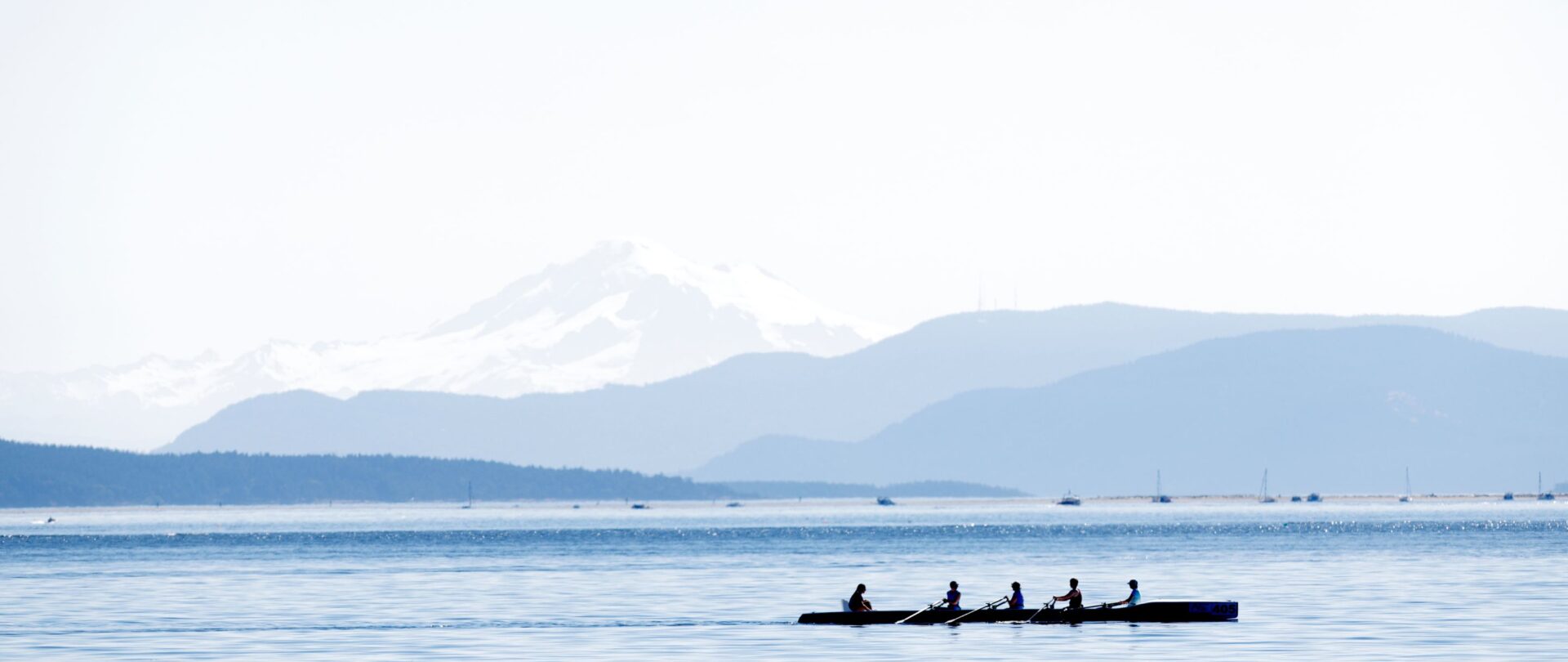
Great View

My husband and I talked a lot about the difference in doing a trip like this rowing versus canoeing or kayaking. The biggest difference is how far we could go. Rowing is much more efficient so we could cover greater distances even in rough conditions. We also liked the safety aspect of the double rowing shell. If one of us got hurt, or sick, or just tired, the other one could row and we would move right along. If there was a serious accident or illness, we could actually remove one of the riggings and a person could lie down. On the negative side, facing backwards isn't ideal when there are deadheads or other obstacles in the water. Tahtsa Lake was flooded as part of the Nechako Reservoir but wasn't logged first. As a result, there were often dead trees and partially submerged logs when we approached the shore. We decided that in the future, we'd bring along canoe paddles so that when we encountered conditions such as the ones we found at Tahtsa, we could just turn forward in our seats and become an instant canoe.

By the end of our trip we definitely agreed with Water Rat's comment to Mole that there is nothing half so much worth doing as simply messing about in boats. Especially if it is a boat you can row.

Rowing Canada Aviron